Construction and the Intelligence We Don’t Measure
Trade skills define a kind of intelligence the UK construction industry has never been taught to measure.
We just learned to praise only one.
People say the construction industry is where you end up if you couldn’t do anything else.
Anyone who has actually worked a site knows that isn’t true.
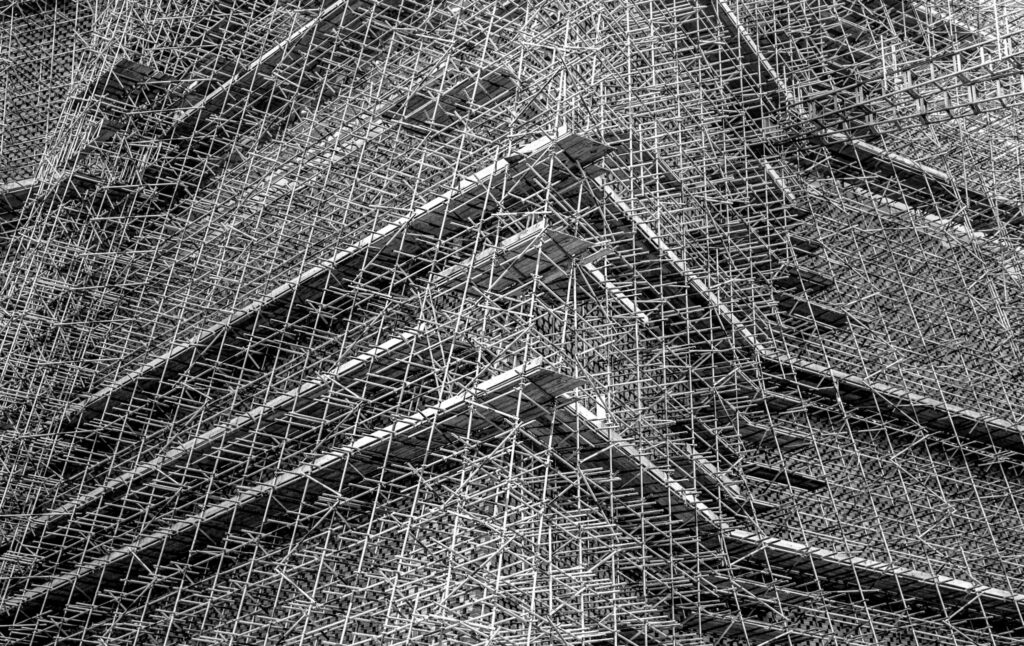
“ London Scaffolding at Tate Modern ” — photographed by Jan Knappe. Licensed under CC BY-SA 3.0.
There’s a quiet line that runs through the industry, sometimes spoken, sometimes implied.
If you weren’t academic, you go into construction.
As if building is where you send the leftovers.
As if the brains live in offices and the hands live outdoors.
The truth looks nothing like that.
This is what From The Boots Up exists to document —
the construction industry and the intelligence we don’t measure.
The skills gap tells its own story
Government response to the construction skills gap
According to the Office for National Statistics, the construction industry has over 35,000 job vacancies, and more than half of them can’t be filled because the required trade skills simply aren’t available.
It’s the biggest skills gap of any UK sector even as demand grows for new homes and modern infrastructure.
According to the Office for National Statistics, the UK construction industry has over 35,000 job vacancies, and more than half cannot be filled because the required trade skills simply aren’t available.
It’s the biggest skills gap of any UK sector — even as demand grows for new homes, safer buildings, and modern infrastructure.
Watch the work for five minutes and you’ll see why the gap exists.
People who judge weight and tension by feel.
Cut true without a laser.
Place steel with hand signals and trust.
Keep gauge in wind, heat, and pressure.
Move plant with millimetre accuracy when mistakes cost lives.
This is intelligence.
Not classroom intelligence.
Lived, embodied intelligence — the kind you can’t fake.
The problem isn’t a lack of smart people.
The problem is that society only recognises one kind of smart.
Two different kinds of intelligence, one world
During an office move at a major engineering firm, a senior engineer — respected, published, brilliant — struggled to assemble a cardboard box.
Turned it.
Flattened it.
Tried again.
An assistant walked over and snapped it together in seconds.
No embarrassment.
No judgement.
Just two different forms of knowledge.
His intelligence lived in systems, models, and theory.
Hers lived in hands, sequence, and spatial awareness.
Both are real.
Both are valuable.
Both keep the world running.
Different intelligence isn’t lesser intelligence.
We just learned to celebrate one and ignore the other.
“It’s just construction” is a lie
When someone says it’s “just construction,” ask if they’ve ever seen someone land steel onto bolts in the wind.
That’s judgement and timing under pressure.
Ask if they’ve watched a telehandler operator place a pallet on flexing scaffold.
That’s physics, balance, and risk management in motion.
Ask if they’ve seen a bricklayer keep line and level with weather closing in.
That’s discipline, rhythm, and focus.
Ask if they’ve watched a roofer judge angles, tension, and fixing points without ever pulling out a calculator.
That’s geometry and durability, done instinctively.
Ask if they’ve seen a groundworker read soil the way some people read spreadsheets — knowing instantly what will hold, what will shift, and what will fail.
That’s material science, lived from the earth upwards.
If you think the work is unskilled, you’ve never watched it properly.
This isn’t about lifting construction workers up.
They were already standing tall.
This is about correcting the record.
Construction is not Plan B.
Construction is the plan everything else depends on.
Every industry uses construction as its foundation.
Every skyline, every home, every road, every hospital, every school, every power station — all of it starts with someone in boots making a decision, under pressure, with real-world consequences.
No offices.
No hospitals.
No homes.
No roads.
No bridges.
No skylines.
Nothing exists without the people who know how to think through their hands the people whose intelligence is lived, not measured.
We call it “trades.”
But what we’re really talking about is the quiet architecture of civilisation, built by people who rarely get credit for the precision, discipline, and craft they carry.
Construction is not the fallback.
Construction is not the consolation prize.
Construction is not where you go when you’ve run out of options.
Construction is the industry that makes all other industries possible.
And it’s time the world said that out loud.
Written by
FTBU Editorial
© FTBU 2025